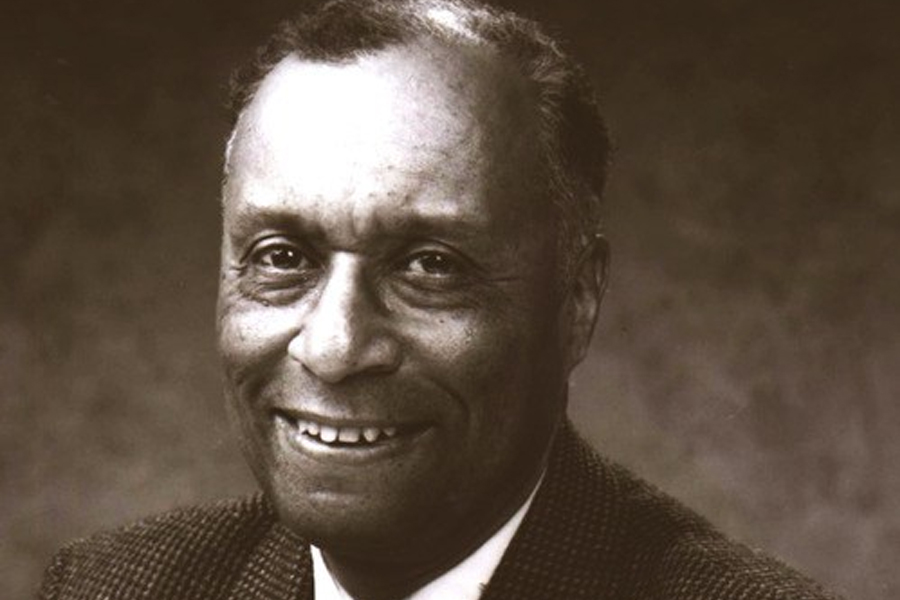
Basic Information
| Category | Details |
|---|---|
| Full Name | Henry Thomas Sampson Jr. |
| Born | April 22, 1934 |
| Birthplace | Jackson, Mississippi |
| Died | June 4, 2015 |
| Age at Death | 81 |
| Profession | Nuclear engineer, inventor, aerospace professional, author, film historian |
| High School | Lanier High School, Jackson, Mississippi |
| Undergraduate Degree | B.S. Chemical Engineering, Purdue University, 1956 |
| Graduate Education | M.S. Engineering, UCLA, 1961; M.S. Nuclear Engineering, University of Illinois, 1965 |
| Doctorate | Ph.D. Nuclear Engineering, University of Illinois, 1967 |
| Historic Distinction | First African American to earn a Ph.D. in nuclear engineering in the United States |
| Major Invention | Gamma electric cell, patented in 1971 with George H. Miley |
| Major Employer | The Aerospace Corporation |
| First Wife | Elizabeth Boland |
| Second Wife | Dr. Laura Howzell Young Sampson |
| Children | Henry T. Sampson III and Martin T. Sampson |
| Parents | Henry T. Sampson Sr. and Esther Ellis Sampson Marshall |
| Brother | John B. Sampson |
| Known For | Nuclear engineering, aerospace technology, patents, Black film history, cultural preservation |
The Early Life of Henry T Sampson
When I look at Henry T. Sampson Jr.’s life, what stands out first is not a single invention but the extraordinary range of his curiosity. He could move from nuclear engineering to rocket technology, then from satellites to silent films, and somehow make each subject part of the same lifelong search for knowledge.
Sampson was born on April 22, 1934, in Jackson, Mississippi, to Henry T. Sampson Sr. and Esther B. Ellis Sampson. He grew up during segregation, in a period when educational and professional opportunities for Black Americans were sharply restricted. His parents nevertheless placed enormous importance on education, dignity, discipline, and intellectual achievement.
He graduated from Lanier High School in Jackson in 1951 and initially attended Morehouse College. His interests at the time included medicine and chemistry, but his academic path eventually turned toward engineering.
That decision opened the door to a career that would take him into some of the most technically demanding areas of postwar American science.
His Parents and Family Foundation
Henry T. Sampson Sr. was himself an accomplished educator. Born and raised in Quitman, Georgia, he was the son of John Henry Sampson, who operated a grocery store, and Louella Gray Sampson, a third grade teacher.
After his father’s early death, Henry Sr. worked to help support the family and also assisted his sister Rubye Louise Sampson in attending Spelman College. His own education included a B.S. in mathematics from Morehouse College in 1929 and an M.S. in mathematics from the University of Chicago in 1933.
He eventually became a mathematics professor and later an executive dean at Jackson College, now Jackson State University. The H.T. Sampson Library at Jackson State carries his name, creating an especially fitting connection between father and son because Henry Jr. would eventually place a major part of his own historical collection there.
Henry Jr.’s mother, Esther Ellis Sampson Marshall, was equally remarkable. Born March 6, 1911, in Vicksburg, Mississippi, she became a pioneering professional social worker.
Esther earned a B.S. from Jackson State College and a master’s degree in social work from Atlanta University. She became the first professional African American social worker in Mississippi and remained deeply involved in social services, education, and early childhood development. She later served as executive director of Project Head Start in Hinds County and became an associate professor at Jackson State University.
She lived to the age of 99, dying on February 7, 2011, in Austin, Texas.
The family story therefore feels almost architectural to me. Education was not simply encouraged in the Sampson household. It was built into the family’s identity.
His Brother John B Sampson
Henry Jr. was the eldest child. His younger brother, John B. Sampson, was born September 3, 1935.
John also pursued technical education and studied electrical engineering, including work associated with Wayne State University. Family accounts portray the brothers as connected throughout their lives, even as their professional paths developed independently.
John later left a public remembrance after Henry Jr.’s death, adding a personal voice to the tributes surrounding the celebrated engineer.
The next generation also carried the family’s professional tradition. Among Esther’s grandchildren were Dr. John B. Sampson Jr. and attorney Mark A. Sampson, alongside Henry T. Sampson III, Martin T. Sampson, and Dr. JoAnn S. Welch.
Education and the Road to Nuclear Engineering
Sampson’s academic progression was remarkably deliberate.
After Morehouse, he attended Purdue University and earned a B.S. in chemical engineering in 1956. He was also a member of Omega Psi Phi. Purdue gave him the technical foundation that would later become essential to his work with propellants, nuclear systems, and aerospace technology.
He then earned an M.S. in engineering from UCLA in 1961.
His next destination was the University of Illinois Urbana Champaign, where he earned an M.S. in nuclear engineering in 1965 and a Ph.D. in nuclear engineering in 1967.
That doctorate represented a historic first. Sampson became the first African American to earn a Ph.D. in nuclear engineering in the United States.
I find the timing especially significant. This was the 1960s, when the American space program was accelerating and nuclear technology was becoming increasingly important to national defense and energy research. Sampson entered that world carrying both extraordinary technical preparation and the burden of breaking barriers that should never have existed in the first place.
Engineering Rockets and High Energy Materials
After Purdue, Sampson joined the U.S. Naval Ordnance Test Station at China Lake, California.
From approximately 1956 to 1961, he worked as a research chemical engineer on high energy solid propellants and materials used in solid rocket motors. He investigated internal ballistics and pioneered studies involving high speed photography.
The work was highly technical, but the social environment could be just as challenging. Sampson later described encountering racial discrimination while searching for engineering employment after graduating from Purdue. Some employers openly indicated that they were not hiring Black engineers.
Instead of allowing those barriers to define his career, he continued forward.
His engineering work eventually included patents involving propellant binders and case bonding systems. His technical contributions were part of a broader career in propulsion, nuclear engineering, aerospace systems, and satellite technology.
The Gamma Electric Cell and the Cell Phone Myth
Sampson’s best known invention was the gamma electric cell, developed with nuclear engineering colleague George H. Miley.
The patent was issued on July 6, 1971, as U.S. Patent 3,591,860. The technology involved converting gamma radiation directly into electricity.
The idea was deceptively simple in description but sophisticated in application. Gamma radiation is energetic, and Sampson’s invention explored ways of capturing that energy and turning it into useful electrical power.
Potential applications included nuclear reactor shielding, radiation detection, auxiliary power systems, and long duration power sources for specialized space technology.
There is one persistent misunderstanding that deserves special attention. Sampson did not invent the cell phone.
Internet articles have repeatedly attached this claim to his name, but Sampson himself clarified that the gamma electric cell and cellular telephone technology were entirely different things. His actual achievement was already remarkable without adding a fictional invention to it.
His Career at The Aerospace Corporation
Around 1967, after completing his doctorate, Sampson joined The Aerospace Corporation in El Segundo, California.
His career there stretched for decades. He served as a project engineer and later held senior leadership responsibilities connected with the Space Test Program.
His work involved planning, acquisition, development, launch, and operation of experimental satellites. He supported programs involving approximately 13 low Earth orbit experimental satellites and evaluated different approaches to spacecraft power.
His interests included nuclear power, photovoltaic systems, magnetohydrodynamic power, and hybrid vehicle and power systems. He also developed computer simulations for complex aerospace applications.
By the time he retired in August 2004, Sampson had accumulated roughly four decades of professional engineering experience.
A Second Career in Black Film and Entertainment History
Sampson’s story twists here.
He became a dedicated historian and collector of African American entertainment while pursuing an outstanding engineering profession.
Tent performances and all Black films in Jackson, Mississippi, sparked his interest early. He collected countless films, posters, recordings, sheet music, books, and other resources about Black culture in America.
His writings include Blacks in Black and White: A Source Book on Black Films (1977), Blacks in Blackface: A Source Book on Early Black Musical Shows (1980), and The Ghost Walks: A Chronological History of Blacks in Show Business, 1865 to 1910 (1988).
He released That’s Enough Folks: Black Images in Animated Cartoons, 1900 to 1960 in 1998 and key works on African Americans in radio and television from 1925 to 1955.
A second legacy followed. Sampson studied nuclear particles, rockets, satellites, and electricity. The other safeguarded generations of Black performers’ culture.
His Film Collection at Jackson State University
In 2011, Sampson donated his extensive film and entertainment collection to Jackson State University.
The collection represented more than 40 years of collecting and research. It included rare films, posters, recordings, memorabilia, books, and other historical materials covering decades of African American cultural history.
The collection became associated with the H.T. Sampson Library, named after his father.
Its grand opening took place in 2019, several years after Sampson’s death, with his widow Laura Young Sampson and members of the family participating.
To me, there is something beautifully circular about this. His father had a library named after him, and Henry Jr.’s life’s work eventually became part of that same intellectual space.
Marriage to Elizabeth Boland and His Children
Sampson married Elizabeth Boland in Las Vegas in January 1961.
The couple had two sons.
Henry T. Sampson III was born in July 1962, followed by Martin T. Sampson, who was born June 21, 1968.
Public information about the brothers’ adult careers and personal lives is relatively limited. That privacy stands in contrast to their father’s extensive professional record.
Sampson remained connected to his children and wider family while building his demanding engineering and scholarly career.
Marriage to Dr Laura Howzell Young Sampson
In 2007, Sampson married Dr. Laura Howzell Young Sampson.
Laura was an associate professor in the College of Education at California State University, San Bernardino. She was also closely involved with Henry’s writing and historical work.
After his death, she spoke about his humility, intelligence, and approach to scholarship. She participated in events surrounding his collection at Jackson State University and assisted with his autobiographical writings.
The couple also worked on a planned biography of Henry’s mother, Esther Ellis Sampson Marshall. That project reflected another important dimension of Henry’s character: he was not interested only in preserving public history. He wanted to preserve family history as well.
Awards and Recognition
Sampson’s accomplishments brought recognition from both engineering and cultural institutions.
Among his honors were recognition from the U.S. Atomic Energy Commission, awards connected with The Aerospace Corporation, the Robert H. Herndon Black Image Award, and an Outstanding Contributions in the Field of Engineering award from the Los Angeles Council of Black Professional Engineers.
He received the George Washington Carver Renaissance Inventors Award in 2008 and an Alumni Award for Distinguished Service from the University of Illinois College of Engineering in 2009.
He also received Purdue engineering alumni recognition and was named Entrepreneur of the Year in 2012 through a California State University Los Angeles related engineering and technology organization.
These honors reveal the unusual breadth of his career. He was recognized not simply as an engineer, but as an inventor, educator, historian, collector, and advocate for intellectual achievement.
Henry T Sampson’s Later Years and Death
Sampson retired from The Aerospace Corporation in August 2004.
He continued writing, collecting, and contributing to historical and educational projects after retirement. His work remained unusually active for someone who had already completed a long aerospace career.
He died on June 4, 2015, in Stockton, California, at the age of 81. His death was attributed to respiratory failure and pneumonia.
A memorial service was held in July 2015 at Rolling Hills Covenant Church. His wishes included cremation, with his ashes scattered overlooking the Palos Verdes Peninsula.
His death marked the end of a remarkable personal journey, but not the end of the work he had spent decades assembling. His books remained available to researchers, his patents remained part of the technical record, and his film collection continued to educate new generations.
Henry T Sampson’s Family Legacy
Sampson family history goes beyond one notable engineer.
The family’s math and higher education focus was exemplified by Henry T. Sampson Sr. His mother, Esther Ellis Sampson Marshall, pioneered social work and education. Brother John studied electrical engineering. Henry III and Martin were his descendants, and his extended family includes doctors, lawyers, educators, and others.
Esther’s obituary listed five grandkids and five great-grandchildren.
Education and service are dual themes of the family tradition. Henry Jr. combined engineering and aerodynamics with African American cultural preservation.
Henry T Sampson’s Financial Status
There is no reliable public figure for Sampson’s net worth, salary, or estate value.
His long career as a senior engineer at The Aerospace Corporation provided a stable professional foundation, and his inventions and books added to his body of work. However, there is no evidence that he accumulated extraordinary celebrity style wealth.
His most significant legacy assets were intellectual rather than financial. His patents, books, technical research, and enormous historical collection represented decades of work that continued to have value after his death.
Frequently Asked Questions
Who was Henry T Sampson?
Henry T. Sampson Jr. was an American nuclear engineer, inventor, aerospace professional, author, and film historian who lived from April 22, 1934, to June 4, 2015.
What did Henry T Sampson invent?
He co invented the gamma electric cell with George H. Miley, a technology designed to convert gamma radiation directly into electricity.
Did Henry T Sampson invent the cell phone?
No. Sampson repeatedly rejected the claim that he invented the cell phone, and his actual invention was the gamma electric cell.
What was Henry T Sampson’s greatest academic achievement?
He became the first African American to earn a Ph.D. in nuclear engineering in the United States when he completed his doctorate at the University of Illinois in 1967.
Who were Henry T Sampson’s parents?
His parents were Henry T. Sampson Sr., a mathematics professor and educational administrator, and Esther Ellis Sampson Marshall, a pioneering Mississippi social worker and educator.
Did Henry T Sampson have children?
Yes. He had two sons with his first wife, Elizabeth Boland: Henry T. Sampson III, born in July 1962, and Martin T. Sampson, born June 21, 1968.
Who was Henry T Sampson’s second wife?
His second wife was Dr. Laura Howzell Young Sampson, an educator and associate professor who also assisted with his writing and historical projects.
What did Henry T Sampson do at The Aerospace Corporation?
He worked as a project engineer and later held senior responsibilities connected with the Space Test Program, contributing to satellite development, launch operations, spacecraft power research, and experimental aerospace systems.
What books did Henry T Sampson write?
His books included Blacks in Black and White, Blacks in Blackface, The Ghost Walks, That’s Enough Folks, and works documenting African Americans in radio and television.
Where is Henry T Sampson’s collection today?
A major portion of his extensive African American film and entertainment collection was donated to Jackson State University in 2011 and became associated with the H.T. Sampson Library.