A private life shaped by family, memory, and history
When I look at Ilham Yassin’s story, I see the outline of a life that never asked for a spotlight yet became part of one of the most closely watched royal families in the Arab world. Her name is most often tied to Queen Rania of Jordan, but that simple label hides a much larger human picture. Ilham Yassin is remembered as a mother, wife, grandmother, and family anchor. Her life sits like a steady lamp in the background, not dazzling on its own, but giving warmth to everyone around it.
Public details about her are limited, and that makes her all the more intriguing. She is not known for a public career, political office, or business empire. Instead, her public identity is built through relationships, family milestones, and the way she appears in rare but meaningful moments with her daughter Queen Rania and the wider Hashemite family. That is often how the most influential private figures exist, quietly, like roots beneath a tall tree.
Palestinian roots and family beginnings
Ilham Yassin is widely described as a Palestinian woman whose family story is connected to the West Bank. Different public accounts place her origins in places such as Tulkarm or Nablus, but the deeper truth remains consistent. Her family comes from the landscape of Palestine, carrying the memory of place across borders and generations.
Her husband was Faisal Sedki Al Yassin, a physician whose life also moved between Palestine, Kuwait, and Jordan. Together, they built a family that would later become known across the region. Their life was shaped by movement, migration, and history, the kind of life where a family home can feel less like one fixed building and more like a line carried from one country to another. That experience appears to have shaped the children they raised.
I think of their household as a bridge family. One side faced the old world of Palestinian identity and memory. The other side opened toward modern Jordanian royal history through their daughter Rania. In between stood Ilham, holding the family together with the invisible strength that often goes unnamed.
A mother of three children
Ilham and Faisal Al Yassin have three children, each of whom followed a different route while remaining close to the family.
Dina Yassin, their oldest daughter, is the most private. Many say she’s three years older than Queen Rania. Her life has mostly been private, but she has appeared in family news and been related to Jordanian political and social circles through marriage.
They had a second child, Rania Al Abdullah, who married King Abdullah II and became Queen Rania of Jordan. The world knows Rania best of Ilham’s children. Even under the spotlight of royal life, Rania’s kindness often references her childhood. Her grace, poise, and family-first image seem to come from her upbringing.
Magdi or Majdi Yassin, their youngest son, likewise lived in private. He is known through family references, notably during weddings and parties. He added another generation to Ilham’s family tree, preserving the steady pulse of daily existence disguised behind remarkable attentiveness.
Marriage, loss, and the weight of time
Ilham Yassin’s husband, Faisal Sedki Al Yassin, was a physician, educated abroad and later employed in Kuwait before retiring in Jordan. His death in May 2022 marked a major moment for the family. In the public record, his passing was treated not just as the loss of a husband and father, but as the closing of an old chapter in a family story that has stretched across decades and countries.
That kind of loss changes the shape of a family. It turns memory into a shared shelter. For Ilham, it also reinforced her role as the surviving elder in a family now deeply woven into Jordan’s royal present. She stands at the center of a family that has moved from private Palestinian beginnings into public royal history. That transition is dramatic, but her own presence remains calm. She is not a symbol made of noise. She is a symbol made of continuity.
Connection to Queen Rania and the Jordanian royal family
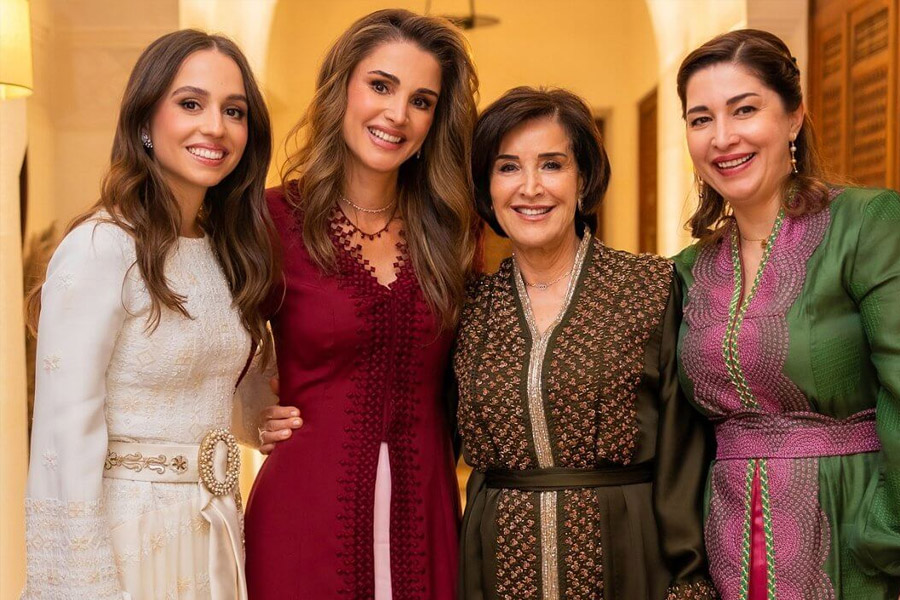
Ilham Yassin is most often identified as Queen Rania’s mother, and that connection has made her familiar to people who follow Jordan’s royal family. Queen Rania has often shared affectionate family moments that include her mother, especially on Mother’s Day and during family celebrations. These images matter because they reveal that even inside a royal household, the emotional architecture remains deeply familiar. There are mothers, daughters, sisters, brothers, husbands, children, and grandchildren. Titles may change, but family rituals stay human.
Through Rania, Ilham became connected to King Abdullah II and to the Hashemite monarchy. Her grandchildren include Crown Prince Hussein, Princess Iman, Princess Salma, and Prince Hashem. Later, the family grew again with the birth of a new generation, including Princess Iman bint Al Hussein and Princess Amina. That means Ilham’s legacy is not just tied to her daughter’s reign. It continues through the next branches of the family tree, where each child carries a piece of the older world forward.
Public image, private life, and the shape of influence
The public career dossier of Ilham Yassin is lacking. Her professional title, business profile, political record, and official appointments are unknown. Instead, she influences relationships. That kind of effect is often overlooked but greatest. A matriarch can build a dynasty without an office. A constant presence goes beyond speeches.
Ilham’s story is mostly told through family celebrations, which I find important. A Mother’s Day tribute. Bridal appearances. Rare photos. These are important details. On a long, private thread are visible beads. They show a woman whose life has been about perseverance, care, and continuity, not self-promotion.
A family timeline in broad strokes
Ilham’s story begins in a Palestinian family setting, then moves into the larger sweep of regional history. Her children were born in the late 1960s and early 1970s. One daughter became queen. One daughter remained deeply private. One son carried the family line forward in his own way. Her husband lived as a doctor and migrant professional before his death in 2022. Her grandchildren entered public life through royal milestones that attracted wide attention.
That timeline may sound formal, but in lived terms it reads like a family album with shifting borders. First comes the old homeland. Then comes displacement and adaptation. Then comes Kuwait, Jordan, and the royal court. Then come grandchildren and great-grandchildren, each one a new leaf on the same branch. Ilham is at the center of that branch, the quiet trunk holding the weight of the canopy above.
FAQ
Who is Ilham Yassin?
Ilham Yassin is best known as the mother of Queen Rania of Jordan. She is a private Palestinian-Jordanian family matriarch whose public presence is tied mainly to her family.
Who is Ilham Yassin married to?
She was married to Faisal Sedki Al Yassin, a Palestinian physician. Their marriage produced three children and became the foundation of the family that later connected to Jordan’s royal household.
How many children does Ilham Yassin have?
She has three children: Dina Yassin, Rania Al Abdullah, and Magdi or Majdi Yassin.
Is Ilham Yassin related to King Abdullah II?
Yes. She is the mother of Queen Rania, who is married to King Abdullah II of Jordan. That makes Ilham part of the extended royal family through her daughter.
Who are Ilham Yassin’s grandchildren?
Her grandchildren through Queen Rania include Crown Prince Hussein, Princess Iman, Princess Salma, and Prince Hashem. The family has since expanded with the next generation as well.
What is known about Ilham Yassin’s career?
There is no widely documented public career for Ilham Yassin. She is generally described through her family role rather than through a professional or political career.
Why is Ilham Yassin often mentioned in the news?
She appears in family coverage connected to Queen Rania, especially around Mother’s Day, weddings, funerals, and major royal milestones.
Where does Ilham Yassin come from?
She is associated with Palestinian roots, and public accounts connect her family to places such as Tulkarm or Nablus in the West Bank.